


Australia recruits skilled workers across a broad range of industries, from hospitality and skilled trades to healthcare, technology, engineering, education and management. For international candidates, understanding where their occupation fits is an important first step when exploring employer sponsored jobs in Australia.
However, having experience in an occupation does not automatically make a person eligible for sponsorship or permanent residency. The outcome depends on several connected factors, including the occupation code, visa pathway, qualifications, work experience, English proficiency, salary, position offered and the sponsoring employer’s circumstances.
This guide explains the main occupational groups, relevant employer-sponsored visa pathways and practical steps candidates can take before applying for jobs in Australia.
What Are Employer Sponsored Jobs in Australia?
Employer sponsored jobs in Australia are positions for which an eligible Australian business nominates an appropriately skilled worker under a relevant visa program.
Depending on the position, location, candidate and employer, the main pathways may include:
- Skills in Demand visa – Subclass 482: a temporary visa for skilled workers nominated by an approved employer.
- Skilled Employer Sponsored Regional visa – Subclass 494: a provisional visa for eligible workers sponsored by employers in designated regional areas.
- Employer Nomination Scheme visa – Subclass 186: a permanent visa for eligible skilled workers nominated by an Australian employer.
The Training visa – Subclass 407 may also be relevant in some circumstances, but it is designed for structured occupational training rather than ordinary employment. It should not be presented as a standard sponsored work visa.
Each visa has its own occupation, nomination, skills, English, salary and employment requirements. Candidates should review the current information published by the Australian Department of Home Affairs before making decisions.
Why Occupational Classification Matters
Australia uses occupational classifications to describe the skill level, duties and requirements associated with different professions.
An occupation is assessed by more than its job title. The candidate’s actual responsibilities, qualifications and experience must align with the nominated occupation.
For example, an employee may hold the internal title “Manager”, but the position may not meet the duties or level of responsibility required for a recognised management occupation. Similarly, two people with the title “Technician” may perform substantially different work and therefore fall under different occupation codes.
Correct occupational classification helps determine:
- Whether the occupation appears on a relevant skilled occupation list;
- Which visa programs may use that occupation;
- Whether a skills assessment is required;
- What qualifications or experience may be expected;
- Whether registration or licensing is necessary; and
- Whether the proposed duties and salary align with the nominated role.
This is why candidates exploring employer sponsored jobs in Australia should prepare a detailed résumé that clearly explains what they do—not just the titles they have held.
Understanding Skill Levels in Australia
Occupations are commonly classified across five skill levels. Skill Level 1 represents the highest general level of skill, while Skill Level 5 covers occupations that usually require lower levels of formal education or shorter workplace training.
The Australian Bureau of Statistics explains that:
- Skill Level 1 is generally comparable to a Bachelor’s degree or higher qualification.
- Skill Level 2 is generally comparable to an Associate Degree, Advanced Diploma or Diploma.
- Skill Level 3 is generally comparable to a Certificate IV or a Certificate III involving substantial workplace training.
- Skill Levels 4 and 5 generally cover occupations requiring lower certificate levels, secondary education or workplace training.
Relevant experience may sometimes substitute for formal qualifications. However, this does not apply in every case. Regulated professions may still require specific qualifications, registration or licensing.
Occupational Groups to Explore
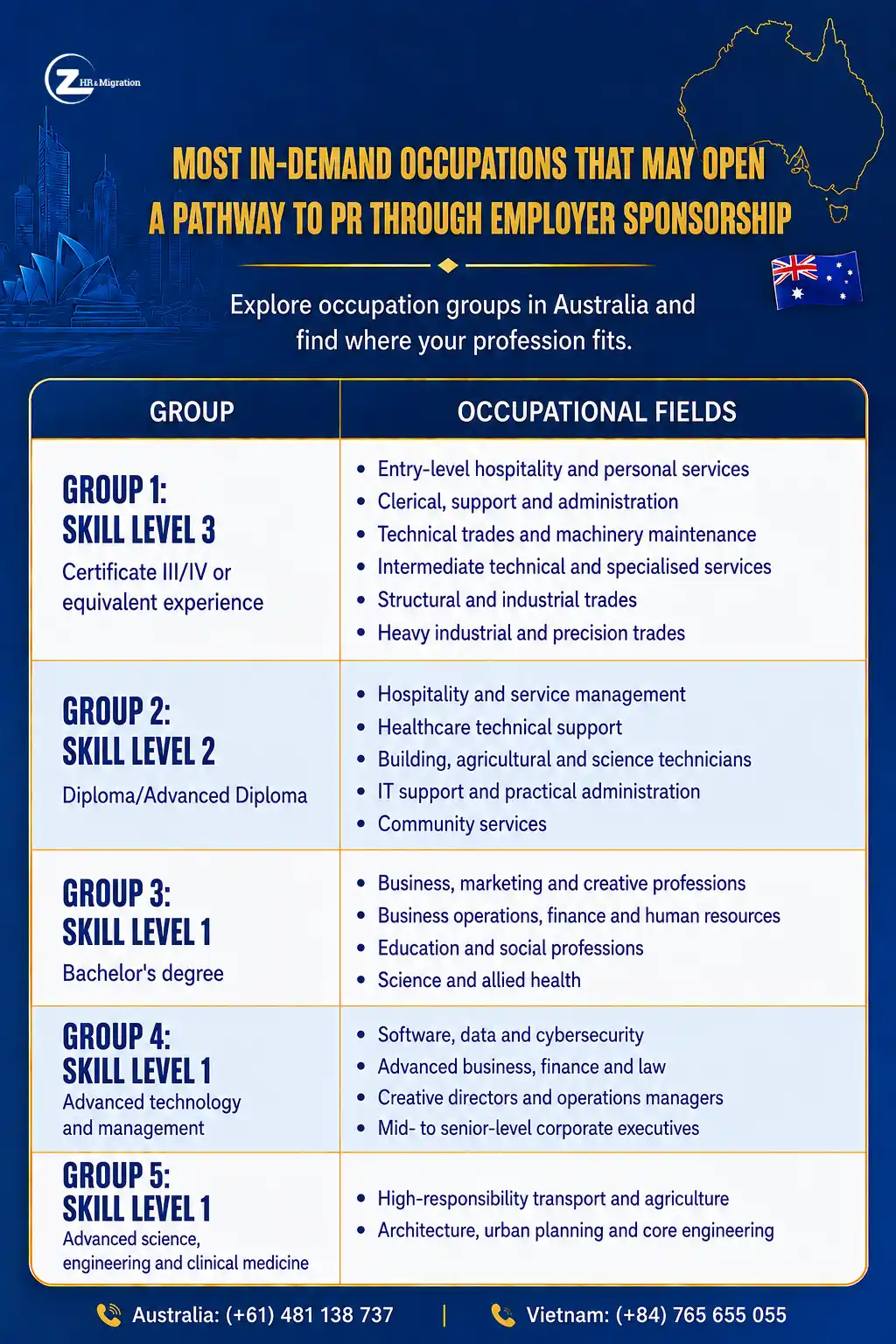
The following five groups provide a practical way to understand the broad range of occupations found across Australia’s labour market. They are an editorial guide—not five official visa tiers—and inclusion in a group does not mean that every occupation is eligible for every sponsored visa.
Group 1: Skill Level 3 Trades and Services
Skill Level 3 occupations are generally associated with an Australian Certificate III or IV, substantial workplace training or relevant experience.
Occupational fields may include:
- Hospitality and personal services;
- Technical trades and machinery maintenance;
- Construction and industrial trades;
- Metal fabrication and welding;
- Automotive services;
- Food trades;
- Structural trades; and
- Heavy industrial and precision trades.
Examples commonly researched by overseas candidates include Cook, Baker, Pastrycook, Butcher, Hairdresser, Carpenter, Welder, Motor Mechanic and Automotive Electrician.
These occupations can be important to the Australian workforce. Jobs and Skills Australia reported that Skill Level 3 positions remained particularly difficult to fill in its March 2026 analysis, although demand varies by occupation and location.
Importantly, a labour shortage does not automatically mean an occupation is eligible for employer sponsorship. The current occupation list and visa requirements must still be checked.
Group 2: Skill Level 2 Technical and Service Roles
Skill Level 2 occupations generally align with a Diploma, Advanced Diploma or Associate Degree, although relevant experience may be considered for some occupations.
Fields in this group may include:
- Hospitality and service management;
- Healthcare technical support;
- Building and engineering technicians;
- Agricultural and science technicians;
- Information technology support;
- Community services; and
- Practical administration.
These roles often involve technical knowledge, coordination, supervision or responsibility for specialised services.
Candidates should be careful when using broad titles such as “Hotel Manager”, “Office Manager” or “Engineering Technician”. The size of the business, level of authority, actual duties and organisational structure can be relevant when determining whether the position matches a nominated occupation.
Group 3: Skill Level 1 Professional Occupations
Skill Level 1 occupations are usually associated with a Bachelor’s degree or higher qualification.
Fields may include:
- Business, marketing and creative professions;
- Finance, accounting and human resources;
- Education and social professions;
- Science and allied health;
- Engineering;
- Information technology; and
- Professional advisory services.
Some occupations may also require registration, professional membership or a positive skills assessment. Healthcare and teaching roles, for example, can involve professional registration and specific English-language standards in addition to visa requirements.
Candidates seeking employer sponsored jobs in Australia in professional fields should ensure that their qualifications and employment history are supported by clear evidence.
Group 4: Advanced Technology and Management
This group covers Skill Level 1 roles involving specialised technical expertise or substantial management responsibility.
Relevant fields may include:
- Software engineering;
- Data and cybersecurity;
- Systems and network administration;
- Advanced business and finance;
- Legal services;
- Project and operations management;
- Corporate management; and
- Senior technology leadership.
A management title alone is not enough to establish eligibility. The nominated position should be genuine and consistent with the employer’s operations, workforce, turnover and organisational needs.
Candidates should clearly describe:
- The number and level of employees supervised;
- Budget or financial responsibilities;
- Decision-making authority;
- Operational or strategic responsibilities;
- Projects managed; and
- Measurable outcomes achieved.
Group 5: Advanced Science, Engineering and Medicine
This group includes specialised Skill Level 1 occupations that may require advanced education, professional registration, licensing or extensive practical training.
Fields may include:
- Architecture;
- Urban and regional planning;
- Core engineering disciplines;
- Aviation and maritime transport;
- Scientific professions;
- Agricultural management;
- Clinical medicine; and
- Other regulated health professions.
Candidates in these fields may need to complete additional recognition, registration or skills assessment processes before they can work in Australia.
Which Sectors Currently Face Skills Gaps?
Australia’s labour market changes over time. According to the 2025 Occupation Shortage List, 29% of assessed occupations were in shortage, down from previous years. Nevertheless, shortages remained significant across trades, healthcare, education and construction.
The March 2026 reporting also showed that Skill Level 3 roles remained among the most difficult vacancies to fill, while regional employers continued to experience greater recruitment difficulty than metropolitan employers.
This means candidates may encounter opportunities across areas such as:
- Construction and skilled trades;
- Healthcare and allied health;
- Teaching and education;
- Hospitality and food services;
- Automotive and mechanical trades;
- Agriculture and regional industries; and
- Selected technology and engineering fields.
Market demand alone does not guarantee employment, sponsorship or visa approval. Some shortages are limited to particular regions or specialisations, and applicants may still face competition.
Occupation Shortage Lists and Visa Lists Are Different
This distinction is essential when researching employer sponsored jobs in Australia.
The Occupation Shortage List is a labour-market research tool developed by Jobs and Skills Australia. It identifies occupations where employers may be experiencing difficulty recruiting suitable workers.
A skilled occupation list for migration, on the other hand, is used to determine which occupations may be available under particular visa programs.
An occupation may be:
- In shortage but unavailable under a specific visa;
- Available under a visa but not currently classified as being in national shortage;
- Eligible only in particular regional or labour agreement circumstances; or
- Subject to caveats, licensing, salary or skills assessment requirements.
Candidates should therefore avoid treating any online “in-demand jobs” list as confirmation of visa eligibility.
What Employers and Candidates Need to Demonstrate
A successful employer-sponsored process involves both the candidate and the sponsoring business.
Candidate considerations
The candidate may need to demonstrate:
- Relevant qualifications;
- Appropriate employment experience;
- English-language proficiency;
- A positive skills assessment where required;
- Professional registration or licensing;
- Health and character requirements; and
- Genuine suitability for the nominated position.
Employer and position considerations
The employer may need to demonstrate:
- A genuine need for the position;
- Eligibility to sponsor or nominate a worker;
- A role that aligns with the nominated occupation;
- Compliance with salary and employment requirements;
- Labour market testing where applicable;
- Capacity to employ the worker; and
- Compliance with sponsorship obligations.
The salary must reflect the position and applicable program requirements. It is not sufficient to offer a role simply because the candidate is willing to accept it.
How to Prepare for Employer Sponsored Jobs in Australia
Candidates can strengthen their initial profile by preparing the following information:
1. An occupation-focused résumé
Your résumé should clearly show:
- Employment dates;
- Working hours;
- Job locations;
- Main duties;
- Equipment, systems or techniques used;
- Supervisory responsibilities; and
- Relevant achievements.
2. Evidence of qualifications
Prepare clear copies of certificates, diplomas, degrees, academic transcripts and relevant training records.
3. Employment evidence
Useful documents may include:
- Employment reference letters;
- Contracts;
- Payslips;
- Tax or social insurance records;
- Bank statements showing salary payments;
- Organisational charts; and
- Work samples where appropriate.
4. English-language results
Review the English requirements for the intended visa and occupation. Professional registration bodies may apply different standards from the visa program.
5. A realistic pathway assessment
A preliminary assessment should consider the candidate, occupation, employer and visa together. Looking at only one part of the process can lead to an unsuitable strategy.

Frequently Asked Questions
What are employer sponsored jobs in Australia?
They are genuine positions for which an eligible Australian employer may nominate a suitably skilled overseas worker under an applicable visa program.
Which visa is commonly used for employer sponsored jobs in Australia?
The Skills in Demand visa (Subclass 482) is commonly associated with temporary employer sponsorship. The Subclass 494 applies in eligible regional circumstances, while the Subclass 186 may provide permanent residence for qualifying workers.
Does an occupation in shortage guarantee sponsorship?
No. Shortage status indicates labour-market pressure. It does not confirm that the occupation is available under a particular visa or that an employer will offer sponsorship.
Can Skill Level 3 occupations lead to employer sponsorship?
Potentially, yes. Some trade and technical occupations may be available under relevant sponsored pathways. Eligibility depends on the specific occupation, visa stream, candidate and employer.
Can relevant experience replace a qualification?
For some occupations, relevant experience may substitute for formal qualifications under the occupational classification. Other occupations require specific education, registration or licensing. Visa and skills assessment rules must also be considered separately.
Does employer sponsorship guarantee permanent residency?
No. Temporary sponsorship does not automatically result in permanent residency. A candidate must meet the requirements of an available permanent visa pathway at the relevant time.
How can I identify the correct occupation?
Compare your actual duties, qualifications and experience with the official occupational description. Do not rely only on your job title.
Explore Your Employment Profile with Oz HR & Migration
Finding employer sponsored jobs in Australia begins with identifying the right occupation and presenting your experience clearly. The next step is understanding whether your profile aligns with current employer requirements and relevant sponsored pathways.
Oz HR & Migration supports candidates by reviewing employment profiles, identifying relevant occupational areas and connecting suitable applicants with potential job opportunities, subject to employer demand and individual eligibility.
Send your updated résumé and a summary of your work experience for a preliminary review.
Contact Oz HR & Migration
- Australia: (+61) 481 138 737
- Vietnam: (+84) 765 655 055
- Email: contact@ozhrmigration.com
Submit your résumé today to explore suitable job opportunities and understand the next steps for your Australian employment pathway.